
 Login / Register


News & Reviews
-thumb_webp.webp)
Car Tyres: A Deep Dive
19 Dec 2025
For all the attention paid to horsepower figures, suspension geometry charts, and brake upgrade kits, tyres continue to be treated as an afterthought by far too many enthusiasts. This is strange, because tyres are not just another component — they are the interface between every mechanical system in the car and the road itself. Every input you make as a driver is filtered, amplified, or muted by four palm-sized contact patches.
Those four patches are responsible for transmitting acceleration, deceleration, steering input, vertical load, heat, and lateral forces simultaneously. No other component operates under such conflicting demands. Understanding tyres properly doesn’t just make you faster — it makes your car more predictable, safer, and far more rewarding to drive.
This is a technical deep dive intended for people who actually care how a car behaves at the limit, particularly in high-temperature environments like Qatar and the wider GCC.
1. The Contact Patch Myth: It’s Not About Size
A wider tyre does not automatically generate more grip, despite how common that assumption is. What ultimately matters is how effectively the tyre’s rubber interacts with the road surface — and that comes down to pressure distribution, compound behaviour, and temperature.
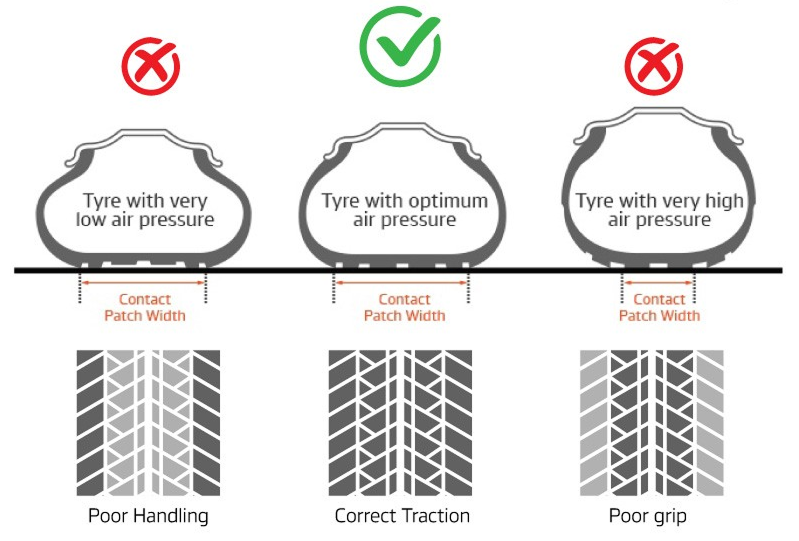
The contact patch is not a fixed shape. It constantly changes depending on load, inflation pressure, cornering force, and braking. When pressure is wrong, the rubber does not work evenly across the tread. Parts of the tyre overheat while others contribute almost nothing.
- A 265-section tyre running incorrect pressure can deliver less usable grip than a properly inflated 235
- Under-inflation increases apparent contact area but reduces carcass stability, causing delayed response and excess heat
- Over-inflation reduces the effective contact patch and leads to abrupt breakaway
In real-world driving, especiallu Contact patch shape vs inflation pressure on hot asphalt, consistency across the tread matters more than headline width numbers.
2. Tyre Construction: Why Sidewalls Define Character
Modern performance tyres are layered composite structures, not simple rubber rings. Each layer exists to manage a specific force, and the way those layers interact defines how the tyre feels long before it reaches the limit.
A typical high-performance tyre consists of:
- A tread compound designed for grip and wear balance
- Steel belts to control deformation under load
- Nylon or aramid cap plies to maintain stability at high speed
- Sidewalls tuned for stiffness, feedback, and load support
Sidewall stiffness is one of the most overlooked variables, yet it has a direct influence on how a car responds to steering input. A softer sidewall allows more compliance and warning before grip loss, while a stiffer sidewall sharpens turn-in but reduces forgiveness.
This is why tyres with identical sizes and similar tread patterns can feel completely different on the same car:
- A Michelin Pilot Sport 4S feels progressive and communicative
- A Pirelli P Zero tends to feel sharper but less tolerant of mistakes
- A semi-slick like a Cup 2 can feel nervous and unsettled when not fully loaded or warmed
The tyre’s construction effectively acts as an extension of the suspension.
3. Rubber Compounds: Heat Is the Real Limiting Factor
Grip does not exist in isolation — it exists within a temperature window. Every tyre compound is engineered to operate best within a specific range, and outside that range performance drops sharply.
| Tyre Type | Optimal Operating Range |
| Touring tyre | ~20–50°C |
| Ultra High Performance (UHP) | ~40–70°C |
| Track-focused / R-compound | ~70–110°C |
Below the optimal range, the rubber remains stiff and cannot conform to the road surface. Above it, the compound overheats, becomes greasy, and begins to tear or smear.
In Qatar, this balance is particularly critical. Road surface temperatures regularly exceed 60°C, meaning some UHP tyres are already close to their upper limit during normal daytime driving. On track, a poorly managed setup can push a tyre beyond its thermal capacity in just a few laps.
This explains why a tyre can feel outstanding during a cool evening drive but vague and unpredictable under the midday sun.
4. UTQG Ratings: Useful, but Easy to Misinterpret
UTQG (Uniform Tire Quality Grading) is often misunderstood or taken at face value. It consists of three metrics:
- Treadwear: a relative wear rating
- Traction: straight-line wet braking performance
- Temperature: resistance to heat-induced failure
A lower treadwear number generally indicates a softer compound and higher potential grip, but UTQG ratings are manufacturer self-certified. This means comparisons are only reliable within the same brand, not across competitors.
A Michelin-rated 300 will not behave the same as a Toyo-rated 300. Treat UTQG as a guideline, not a definitive performance ranking.
5. Load Index & Speed Rating: Structural Integrity Matters
Load index and speed rating are often viewed as regulatory formalities, but for enthusiasts they reveal a great deal about a tyre’s internal strength.
The load index defines how much weight a tyre can safely support at its rated pressure. Running a tyre near or beyond this limit increases sidewall deflection, heat generation, and long-term structural fatigue.
Speed ratings, meanwhile, are not just about top speed:
- W: up to 270 km/h
- Y: up to 300 km/h
- (Y): beyond 300 km/h
Higher speed ratings generally indicate stronger internal construction and better resistance to deformation. This is why a Y-rated tyre often feels more stable and confidence-inspiring even during everyday driving.
6. Tyre Width, Aspect Ratio & Wheel Size: Balancing Compromises
Wheel and tyre upsizing is common, but rarely optimised. Every change introduces trade-offs.
Wider tyres can increase lateral grip potential, but they also generate more heat, are more sensitive to pressure errors, and are prone to tramlining. Lower-profile tyres sharpen steering response but reduce compliance and place greater stress on wheels and suspension components.
In GCC conditions, a slightly narrower tyre with a high-quality compound often delivers more consistent real-world performance than a wide tyre chosen purely for aesthetics.
7. Tyre Wear Patterns Are Diagnostic Tools
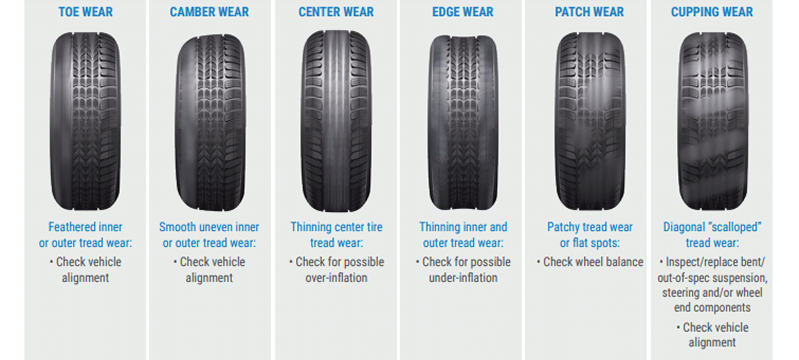
Tyres tell the story of your car’s setup if you know how to read them.
- Centre wear indicates over-inflation
- Shoulder wear on both sides suggests under-inflation
- Inside edge wear points to excessive negative camber
- Feathering indicates incorrect toe settings
- Cupping often reveals worn dampers or imbalance
Uneven wear doesn’t just reduce tyre life — it actively degrades grip and predictability.
8. Age, Heat Cycles & Rubber Degradation
Tread depth alone does not define a tyre’s condition. Over time, repeated heat cycles and oxidation harden the rubber compound.
- After ~3 years: noticeable loss of wet grip
- After ~5 years: significant reduction in overall performance
- Beyond 6 years: performance tyres are often structurally sound but dynamically compromised
For enthusiasts, DOT date codes matter almost as much as brand and model.
9. Choosing Tyres Based on Use, Not Badge
The correct tyre is determined by how you drive, not what you drive.
- Fast daily driving: prioritise progressive breakaway and thermal stability
- Spirited night runs: focus on sidewall support and mid-range heat tolerance
- Track use: accept reduced lifespan in exchange for thermal consistency and feedback
A well-tyred car with modest power will outperform a more powerful car on unsuitable rubber every time.
10. Tyres Are Part of a System
Tyres do not operate in isolation. They interact continuously with alignment settings, damper tuning, brake balance, and weight distribution. Changing tyres without adjusting pressures or alignment leaves performance untapped and can introduce new weaknesses.
Final Thought
Tyres are not consumables — they are tuning tools.
They define how a car communicates, where grip appears and disappears, and whether the limit arrives progressively or without warning. Ignore them and every other modification is compromised. Understand them, and the entire vehicle improves.
Recent Articles
Most Viewed
-thumb_webp.webp)
-thumb_webp.webp)
Advice


Related Articles
-thumb_webp.webp)

-thumb_webp.webp)
-thumb_webp.webp)
-thumb_webp.webp)
-thumb_webp.webp)